

The anti-church career of Viktor Yelensky began in 1982. After graduating from Kyiv National University, Yelensky worked as an inspector at the Council for Religious Affairs under the Cabinet of Ministers of the USSR.
It was during this period that Yelenskyi produced academic works in which he justified the crimes of the Soviet regime against religious organizations, dismissing as lies and fabrications the claims of “anti-Soviet elements” about persecution and the violent eradication of faith in the USSR.
Yelensky praised the policies of V. Lenin and incited hatred against religious leaders. In particular, this is evident in his 1988 academic work “Jewish Clericalism and Zionism.”
After the collapse of the USSR, Yelensky completed a fellowship at Columbia University and, upon returning to Ukraine, worked for Radio Liberty.
Yelensky’s return to anti-church politics took place after his participation in the Euromaidan and the snap parliamentary elections of 2014. The former Soviet specialist became a Member of Parliament from the People’s Front party.
🔴 As an MP, Yelensky laid the foundations for future state persecution of the Ukrainian Orthodox Church (UOC).
He frequently incited hatred against UOC believers and clergy in public statements, denied crimes committed against the Church, and became a co-author of a number of anti-church legislative initiatives.
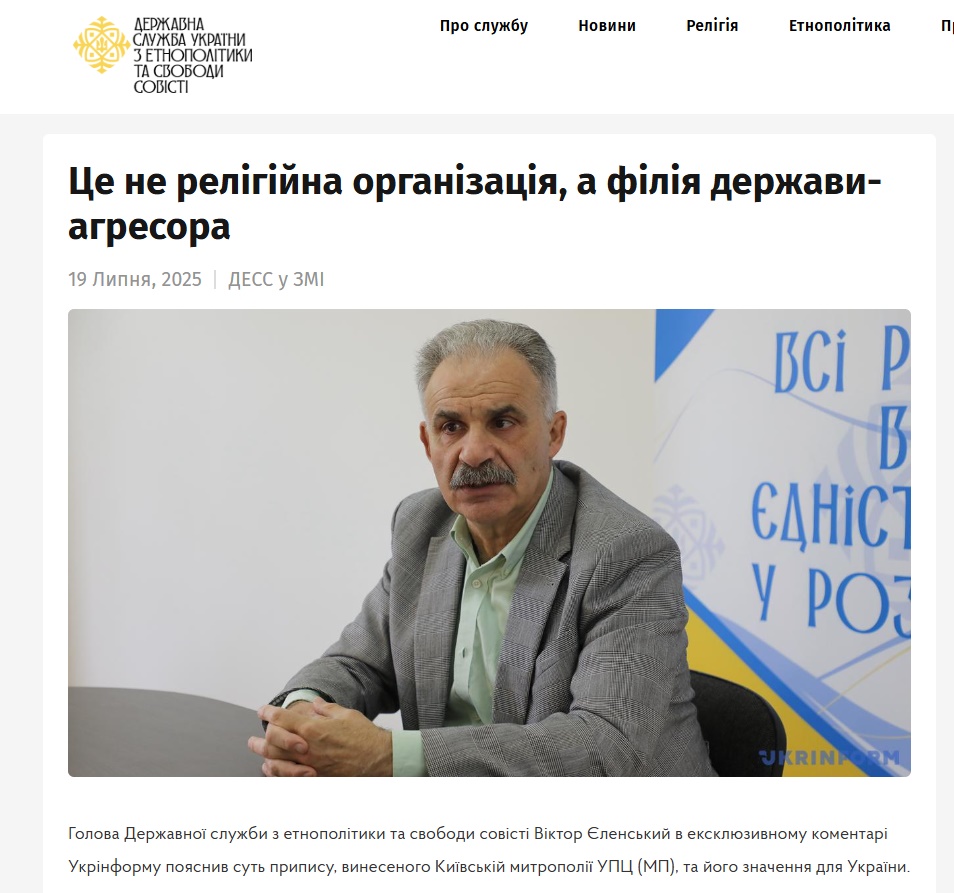
The next stage of Yelensky’s anti-church activity was his appointment as Head of the State Service of Ukraine for Ethnopolitics and Freedom of Conscience (DESS). In this position, the official launched an unprecedented campaign of persecution against the Church and of concealing crimes committed against the UOC.
🔴 In the spring of 2017, Yelensky became a co-author of two draft laws: No. 4128 and No. 4511.
Under draft law No. 4128, any outsider could declare himself a member of a particular parish and vote for its transfer to another jurisdiction.
Dozens of UOC church seizures were carried out using this scheme. As a result of such norms, “a substitution of concepts takes place, whereby a territorial community is equated with a religious community.”
Draft law No. 4511 was aimed at discrediting the UOC and proposed norms of direct state interference in the activities of religious organizations. Under threat of prohibition, legislators demanded that churches conclude agreements with the state and coordinate the appointment of bishops and priests with state officials.
While serving as Deputy Head of the Verkhovna Rada Committee on Culture and Spirituality, Yelensky lobbied anti-church draft law No. 5309, known as the law on the forced renaming of the UOC.
🔴 The authors of the law demanded that communities of the Ukrainian Orthodox Church (UOC) be renamed the Russian Orthodox Church in Ukraine (ROC in Ukraine).
In an interview with Focus magazine dated 25 November 2022, Yelensky stated that the UOC is “a branch that for decades, if not longer, poisoned its believers with the ideologemes of the ‘Russian world.’”
On 19 December 2022, Yelensky was appointed Head of the State Service of Ukraine for Ethnopolitics and Freedom of Conscience (DESS).
🔴 In January 2023, the DESS headed by Yelensky began developing an anti-church draft law aimed at the future banning of the UOC.
The official took an active part in its discussion and drafting.
🔴 On February 1, 2023, DESS announced that, as a result of a so-called religious studies “expert examination” of the Statute on the Governance of the Ukrainian Orthodox Church for the presence of canonical ties with the Moscow Patriarchate, the experts concluded that the UOC remained part of the Russian Orthodox Church and did not even possess the status of an autonomous Church.
The examination itself was conducted by biased supporters of banning the UOC and involved numerous violations.
The examination was carried out pursuant to the decision of the National Security and Defense Council of 1 December 2022, “On Certain Aspects of the Activities of Religious Organizations in Ukraine and the Application of Personal Special Economic and Other Restrictive Measures (Sanctions),” enacted by Presidential Decree No. 820/2022 of 1 December. Under this decree, the DESS was granted the status of a central executive authority.
🔴 On 17 May 2025, the State Service of Ukraine for Ethnopolitics and Freedom of Conscience announced on its Facebook page the launch of inspections regarding the presence of signs of affiliation between the Kyiv Metropolis of the Ukrainian Orthodox Church and a foreign religious organization whose activities are banned in Ukraine.
🔴 On 6 June 2025, the DESS approved the final list of legal entities—religious organizations—classified as “critically important for the functioning of the economy and ensuring the livelihood of the population during a special period.”
In practice, this is a list of religious organizations whose clergy will receive state exemptions and will not be sent to the front as soldiers.
Yelensky’s agency deliberately did not include UOC clergy on these lists. Apparently by mistake, the Pochaiv Lavra of the UOC and the Korets Stauropegial Convent were included, but after a remark made by OCU Bishop Havryil Kryzyna to one of the authors of the “examination” of the UOC Statute, Andrii Smyrnov, this was called a “technical error.” The DESS removed the lists and republished them—this time definitively without the UOC.
🔴 On 8 July 2025, the DESS published the results of a so-called “study,” according to which the Kyiv Metropolis of the UOC is “affiliated” with the Russian Orthodox Church.
The “study” was conducted by DESS employees directly subordinate to Yelensky.
On 17 July 2025, the website of Yelensky’s agency published an order addressed to the Kyiv Metropolis of the UOC demanding the elimination of “violations of legislation on freedom of conscience and religious organizations.”
The order was issued based on the results of the aforementioned “study.” In the event of non-compliance, DESS officials threatened to initiate the liquidation of the legal entity.
🔴On 19 July 2025, Viktor Yelensky called the UOC “not a religious organization, but a branch of the aggressor state.”
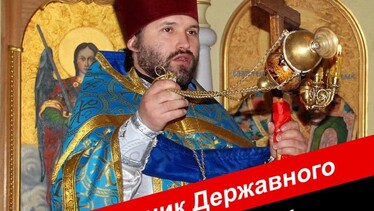
Vicar of the St. Nicholas Church of the UOC-KP (OCU) in the city of Poltava, archpriest of the OCU.
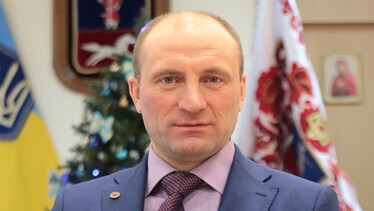
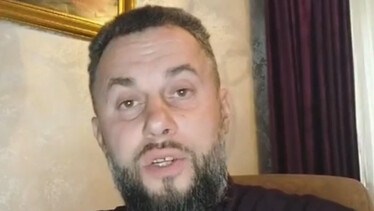
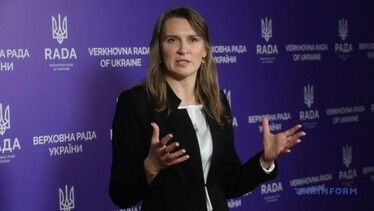
A Member of the Verkhovna Rada of the 9th convocation from the Holos party, a consistent advocate of discrimination against and the banning of the Ukrainian Orthodox Church; formerly a member of the All-Ukrainian Union “Svoboda.”